

Shockwave therapy in Cologne
We have been successfully using this gentle outpatient therapy method for over 16 years. It has proven particularly effective for certain conditions and is increasingly being used as the preferred treatment method.
ESWT is based on the application of mechanical pressure pulses, the so-called shock waves. These are generated, for example, by devices with piezoelectric elements: certain quartz crystals, under electrical voltage, set the surrounding medium into mechanical vibrations.
Shock waves propagate particularly well in water-containing tissues – including those in the human body. When they encounter structures with significantly higher density, such as a ureteral stone or a calcium deposit, they are reflected at the interface between tissue and solid. This results in a high energy transfer, leading to tensile and compressive forces in the affected area.
In focused shockwave therapy (focused ESWT), several shockwaves are concentrated on a small area. This allows a solid object – such as a calcium deposit in a tendon – to be selectively broken up. The resulting small calcium fragments are usually so fine that they can subsequently be absorbed by the body.
Shockwave therapy has proven to be well tolerated so far. Apart from possible temporary increases in pain, especially in the area of calcifications, no harmful side effects are known.
This short-term pain response may be due to the activation of resorption processes in the area of pathological calcification – an indication that the body is responding to the treatment.
Procedure of focused shock wave therapy (ESWT)
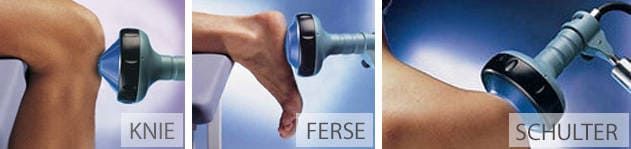
During treatment, the patient lies on an examination table in a supine, prone or side position – depending on which body region is being treated.
Using previously acquired MRI images, the area to be treated is precisely located. The shockwave head of the therapy device is then positioned precisely over the target region.
The treatment itself consists of approximately 2000 impulses of focused shock waves, which are administered with slowly increasing intensity.
Immediately after the session, patients can move normally again and put stress on the treated joint or tissue.
Usually, three treatments at weekly intervals are sufficient.
Only in exceptional cases is a higher number of sessions necessary.
Which diseases can be treated with shock wave therapy?
- Heel pain, for example, caused by a heel spur.
- Tennis elbow, for example, inflammation of the tendon insertions with and without calcium deposits.
- Hip joint pain, for example, due to inflammation from overuse of the tendon attachments
- Knee pain, for example, due to inflammation of the patellar tendon.
- Achilles tendon pain, for example, due to inflammation or deposits in the Achilles tendon.
- Shoulder pain, for example, due to calcifications or inflammation in the tendon or joint capsule.
Online appointment
- Schedule now
Im Zollhafen 6, 50678 Köln, Deutschland
