


Arthritis knee joint
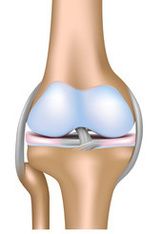
A healthy knee joint: In a healthy knee joint, the articular cartilage – a firm yet elastic tissue – protects the bone ends. It acts as a shock- and friction-absorbing cushion at the contact points of the bones and ensures an even distribution of force within the joint.
The joint space is lined by the synovial membrane (joint lining). This produces the so-called synovial fluid, which ensures smooth joint movement and simultaneously supplies the cartilage with nutrients.
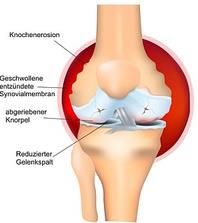
Knee joint with arthritis in the early or advanced stage: In arthritis – an inflammatory disease of the joint – the synovial membrane (joint lining) thickens and becomes inflamed. This inflammation is the main cause of the progressive breakdown of the articular cartilage (cartilage erosion).
The inflammation causes an increased production of synovial fluid, which accumulates in the joint space and leads to swelling.
The result: pain, restricted movement and, in the long term, a loss of cartilage structure in the affected joint.
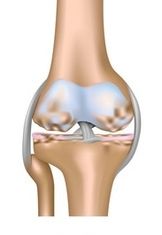
Knee joint with advanced osteoarthritis: Osteoarthritis is a degenerative joint disease that begins with the breakdown of articular cartilage. This is followed by remodeling processes in the adjacent bone – the joint surface is gradually damaged and ultimately destroyed.
Osteoarthritis is characterized by progressive joint degeneration, often accompanied by pain, restricted movement, and inflammation. Unlike arthritis, however, the primary issue here is not inflammation, but rather the mechanical wear and tear of the joint over time.
Arthritis – what exactly is it?
Arthritis is an inflammatory, relapsing-remitting joint disease and belongs to the large group of rheumatic diseases.
These include various forms of arthritis as well as:
- activated osteoarthritis (osteoarthritis with an inflammatory component)
- gout
- soft tissue rheumatism (e.g., inflammation of tendons, bursae, or ligaments)
Typical symptoms of arthritis include pain, swelling and increased warmth in the affected joint – often accompanied by restricted mobility and a general feeling of illness during a flare-up.
Beware of confusion! - Arthritis and osteoarthritis – the differences matter
Arthritis and osteoarthritis are often confused – but they are fundamentally different diseases.
Osteoarthritis is a degenerative, non-inflammatory joint disease in which the cartilage is slowly broken down.
Arthritis, on the other hand, is an inflammatory disease that occurs in two forms:
- Bacterial (purulent) arthritis, caused by germs in the joint
- Non-bacterial arthritis, such as that which occurs in rheumatic diseases.
In osteoarthritis, it's exactly the opposite: the inflammation only arises due to wear and tear and damage to the joint.
How do I recognize the beginning of arthritis?
Symptoms - from the initial stage to the final stage.
Symptoms and course of arthritis
In the early stages, joint pain is often very nonspecific. Many sufferers initially experience it as a general feeling of malaise. Typical symptoms of arthritis include joint pain that occurs suddenly or develops gradually and intensifies over time. Patients often complain of stiffness, especially in the morning, and occasionally of circulatory problems. However, this morning stiffness usually subsides in the early stages.
As the disease progresses, the inflammation increasingly affects the joints. Acute flare-ups occur, which can last for weeks or months and are accompanied by joint pain, swelling, fever, and fatigue.
An X-ray usually only reveals joint damage in the advanced stages of arthritis, often only after several years. Therefore, it is of little help in diagnosis during the early stages. Blood tests are much more important, as so-called non-specific signs of inflammation can provide clues to arthritis.
Magnetic resonance imaging (MRI) offers a particularly precise diagnostic method. It shows the doctor exactly where and how severe the inflammation is, and often provides important clues to its cause.
Possible causes for the development of arthritis:
- Overuse-related inflammatory reaction in the knee joint
- Consequence of a meniscus tear
- Consequence of cartilage damage
- Bacterial infection
- gout
- Activation of existing osteoarthritis
Treatment and therapy: Anti-inflammatory therapy
Physiotherapy
In our practice, we offer targeted physiotherapy for conditions such as arthritis. We select the most suitable program for your specific needs from a variety of methods, including therapeutic exercise, manual therapy, electrotherapy, laser therapy, shockwave therapy, EMG biofeedback, Power Plate, and Cybex training. This allows us to address your individual condition and work specifically towards its improvement.
Cortisontherapie
In cases of severe inflammation, cortisone therapy can be used to quickly suppress the inflammatory response and relieve pain. Cortisone preparations have a strong anti-inflammatory effect and can be administered directly into the joint or as tablets.
A targeted injection into the affected joint can bring rapid relief, especially during acute flare-ups. However, due to potential side effects, cortisone is only used for short periods and in the lowest effective doses.
Together with you, we will consider when and to what extent cortisone therapy is appropriate in order to treat your symptoms in the best possible way.
Hyaluronic acid:
Hyaluronic acid is a natural component of cartilage and synovial fluid. The synthetically produced substance is injected directly into the affected joint. In simple terms, hyaluronic acid acts like a "joint lubricant": it is intended to slow down cartilage degradation, improve knee mobility, and enhance the cartilage's gliding properties.
Hyaluronic acid also has anti-inflammatory properties and can relieve pain. The therapy is particularly promising for patients with early-stage osteoarthritis. While the effect is not immediate, it typically lasts for about six months to a year.
Online appointment
- Schedule now
Im Zollhafen 6, 50678 Köln, Deutschland
